

Every major leap in technology has been about making work flow better. The assembly line automated production. The PC and the internet reshaped knowledge work. Cloud and collaboration tools broke down barriers of place and time. Now, with automation and AI, organizations are chasing the next leap.
The sad part is that many of these investments stall before they reach production, because there's no orchestration layer connecting systems, teams, and data underneath.
An intelligent workflow platform is that layer, combining deterministic automation, agentic AI, and human judgment on a single governed surface. The concept matters now because every prior wave of enterprise technology hit the same integration wall that AI is hitting today.
TL;DR:
An intelligent workflow platform is a single governed environment that unites deterministic automation, agentic AI, and human-in-the-loop processes to move work across systems, teams, and tools without manual handoffs.
Intelligent workflow platforms are "intelligent" because they can pull context from multiple sources, make real-time decisions, and adapt based on conditions. This workflow intelligence moves beyond if/then logic into reasoning.
For every 33 AI POCs a company launches, only four graduate to production. The bottleneck is the orchestration layer underneath. On Tines, 94% of pilots advance to production.
What is an intelligent workflow platform?
An intelligent workflow platform combines automation, AI, and integration into a single environment where work moves across systems and people without manual handoffs. Three modes run side by side: rules-based automation for predictable tasks, AI agents that reason through ambiguity, and human decisions where judgment matters.
Unlike basic automation, which follows a single script from start to finish, an intelligent workflow platform pulls context from multiple sources, makes real-time decisions, and orchestrates actions across the full stack.
What makes intelligent workflows different from legacy automation is the range and flexibility. Deterministic workflows, the kind that follow fixed rules and run the same way every time, handle the predictable bulk.
Agentic workflows let AI agents reason through ambiguity and make decisions within guardrails. Human-led workflows put people at decision points where judgment matters.
Most real-world processes need all three working together, and forcing teams to choose one approach is why legacy platforms never delivered on their promises.
How intelligent workflow platforms work
An intelligent workflow platform sits between the tools an organization already uses and the people who rely on them. It acts as the connective layer that pulls data from one system, makes a decision, and pushes an action into another.
The basic mechanic is a workflow, called a story in Tines (and a playbook in legacy SOAR tools). A workflow is a sequence of steps that runs when something triggers it:
An alert fires
A form is submitted
A scheduled time arrives
Each step can call an API, run logic, ask an AI agent to reason through a decision, or pause to wait for a human to approve or intervene.
What sets intelligent workflow platforms apart from simple automation tools is their ability to combine those step types into a single workflow. For example, if a phishing alert comes in, a rules-based step can enrich the indicators, and an AI agent can score the threat and decide whether it's real.
If confidence is low, the workflow routes to an analyst with all the context pre-assembled. The platform handles the connections, permissions, and logging underneath, so teams can focus on what the workflow should do rather than how to wire systems together.
Why AI alone won't solve the problem
AI gives non-technical teams a fast way to eliminate "muckwork," and the results can feel like a breakthrough. An analyst builds a triage bot. An IT manager automates ticket routing. Each one works on its own.
But without governance (audit trails, role-based access, and policies for how AI and automation run), controls (the guardrails that decide who can do what, when), and integration into the broader stack, those experiments stay isolated.
They can't share context across systems, can't be audited, and can't scale beyond the person who built them.
The Tines Voice of Security 2026 report puts numbers to the problem: 99% of SOCs now use AI in some capacity, yet 76% still report burnout, and 81% say workloads increased. Adding AI without connecting it to the systems and processes around it creates new tasks like monitoring, governance, and prompt management faster than it eliminates old ones. More queue pressure, more brittle glue code, more manual review sitting between one system and the next.
The best organizations treat AI as one ingredient, not the whole recipe. Rules-based automation handles the predictable, repeatable work. AI agents reason through ambiguity and make decisions within guardrails. Humans step in where judgment matters. That combination is what separates teams shipping AI into production from teams stuck in perpetual pilots.
Intelligent workflow platforms build that combination into a single environment with governance from day one. Teams move fast because the guardrails are already in place.
Benefits of an intelligent workflow platform
The right intelligent workflow platform changes how fast teams build, how far workflows scale, and how much control they retain along the way.
Faster time to production: Most automation projects stall in months-long implementation cycles. An intelligent workflow platform compresses that timeline by letting non-specialists build and deploy production workflows in hours, not months.
Compounding time savings: When workflows run across systems without manual handoffs, small efficiencies multiply. A single automated workflow that saves an analyst 30 minutes a day saves the team hundreds of hours a year. Stack dozens of those workflows together, and the impact reshapes how the team spends its time.
Cross-team scalability without re-architecture: The workflow patterns that work for one team transfer directly to the next. The triage-and-route logic that handles security alerts works for IT tickets. The enrichment pattern that assembles context for incident response works for access reviews. One platform, same patterns, different domains.
Governance at speed: Most approaches force a choice between moving fast and maintaining control. Built-in audit trails, role-based access, and AI guardrails mean teams don't have to pick. Every action taken by a person, a rule, or an AI agent is logged and auditable from day one.
Vendor-agnostic integration: Intelligent workflow platforms connect to anything with an API, whether through webhooks, direct integrations, or connections to any LLM provider. No ecosystem lock-in. No waiting for the vendor to build the connector you need.
These benefits compound. A team that builds faster, integrates broadly, and operates with governance from day one doesn't just save time. It creates a foundation that every other team in the organization can build on.
Core components of an intelligent workflow platform
The difference between a useful platform and another purchase comes down to five functional layers. These mirror how work actually flows through an organization, from creation to execution to oversight.
1. Deterministic, agentic, and human-led automation
An effective intelligent workflow platform supports deterministic, agentic AI, and human-led workflows in any combination. Rule-based automation handles the high-volume, repeatable work that never changes.
AI agents reason through ambiguity, pull context from multiple systems, and make decisions within guardrails.
Human-led workflows put people at the decision points where judgment matters. AI in this model is a workflow role that reasons, decides, and acts alongside deterministic and human steps.
2. Governance and audit trails from day one
Built-in governance, audit trails, role-based access, and AI guardrails belong in the architecture from the start, not added after deployment. Every action taken by a person, a rule, or an AI agent should be logged and auditable. Without this layer, speed creates risk instead of reducing it.
3. Vendor-agnostic integration
Vendor-agnostic connectivity means the platform talks to anything with an API, whether that's through webhooks, direct integrations, Model Context Protocol (MCP), or connections to any LLM provider. The integration layer shouldn't care what's on the other end.
4. Dynamic interaction surfaces
Service desks, copilots, forms, and approval interfaces make workflows visible and usable to the people who depend on them. In Tines, these show up as Cases (shared workspaces for incident-style work), Pages (custom forms and approval interfaces), and Story copilot (AI-assisted workflow building)
Human-in-the-loop isn't a feature you add. It's a design principle. People trigger, review, approve, and collaborate within the workflow itself.
5. Workflow creation at any skill level
The platform needs an intuitive environment where people design workflows at their own skill level. Whether someone builds in natural language, visual drag-and-drop, or code, the platform should support their approach. If it only supports one mode, it becomes a bottleneck.
These five layers form the evaluation framework for any intelligent workflow platform. If a platform falls short on any one, it will hit limits in production.
High-value use cases across teams
The same workflow patterns create value wherever structured work crosses multiple systems and requires human judgment. According to the Tines Voice of Security 2026 report, security professionals still spend 44% of their time on manual, repetitive work.
The underlying patterns repeat everywhere: triage and routing, context enrichment, approvals and escalations, and lifecycle workflows that span dozens of tools in a single event.
1. IT operations
IT teams manage a constant stream of requests that cross multiple systems: access provisioning, device lifecycle management, software license assignments and internal support tickets. Each one follows a similar pattern. A request comes in, context needs to be gathered from several tools, a decision gets made, and actions get pushed into downstream systems.
When that process is manual, IT staff spend their time copying information between screens instead of solving problems. An intelligent workflow platform automates the repetitive steps, pulls context from identity providers, asset management tools, and ticketing systems in parallel, and routes decisions to the right person when human judgment is needed.
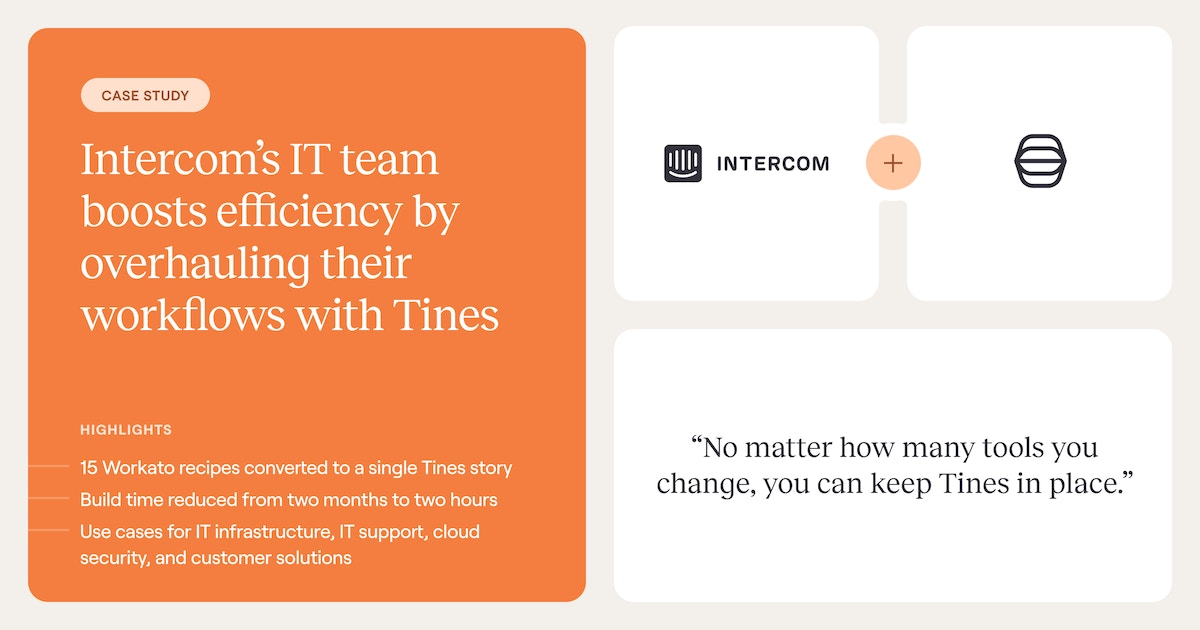
Intercom saw this firsthand. Their IT team was spending months building workflows in their previous platform. After switching, build time dropped to hours, and they consolidated 15 separate workflows into a single Tines story.
At Brex, the same pattern played out in reverse: the security team adopted the platform first, and IT followed after seeing the results. Employee onboarding that once required 5 a.m. manual logins for time-zone-specific provisioning now runs automatically.
2. Security
Security teams face a volume problem. Alert queues grow faster than headcount, and most alerts follow the same investigative steps: enrich, score, escalate or close. An intelligent workflow platform runs those repeatable steps automatically across the full stack, so analysts focus on the threats that actually need human judgment.
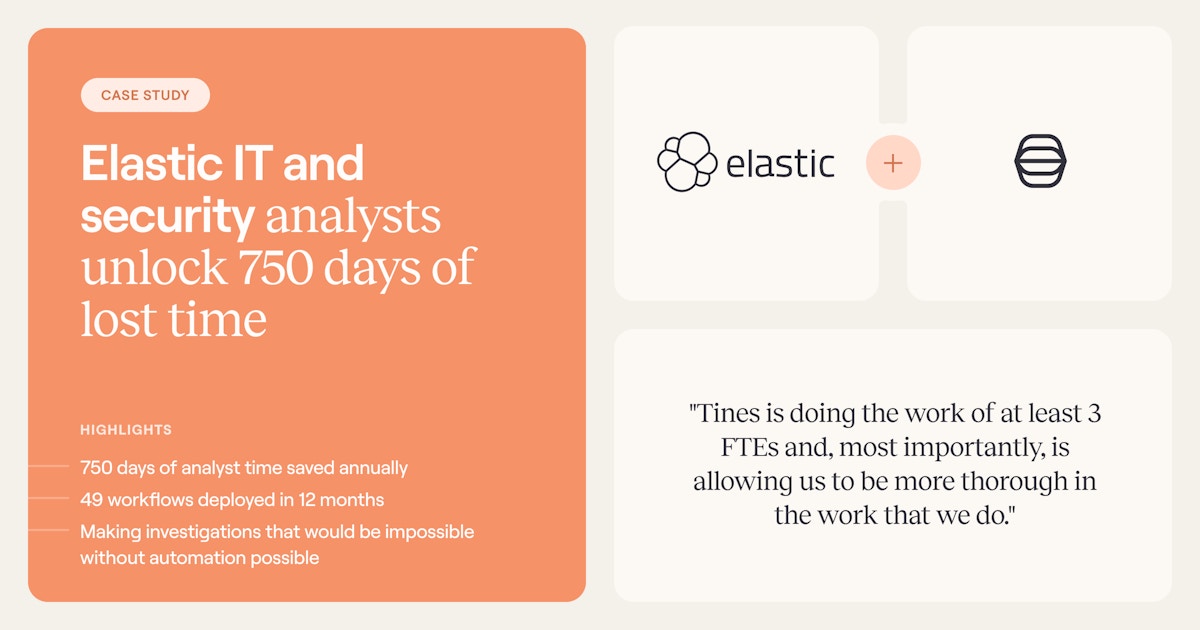
Elastic's security team runs this kind of workflow at scale. Across 49 workflows deployed in 12 months, they saved 750 days of analyst time annually. Their first workflow alone saved 93 days in a single week of execution.
3. Cross-team expansion
The fastest way an intelligent workflow platform spreads inside an organization is through results. One team automates a high-volume process, the numbers improve visibly, and the next team asks how.
The patterns transfer directly. Triage-and-route logic that works for security alerts works for IT tickets. Enrichment workflows that assemble context for incident response do the same for access reviews.
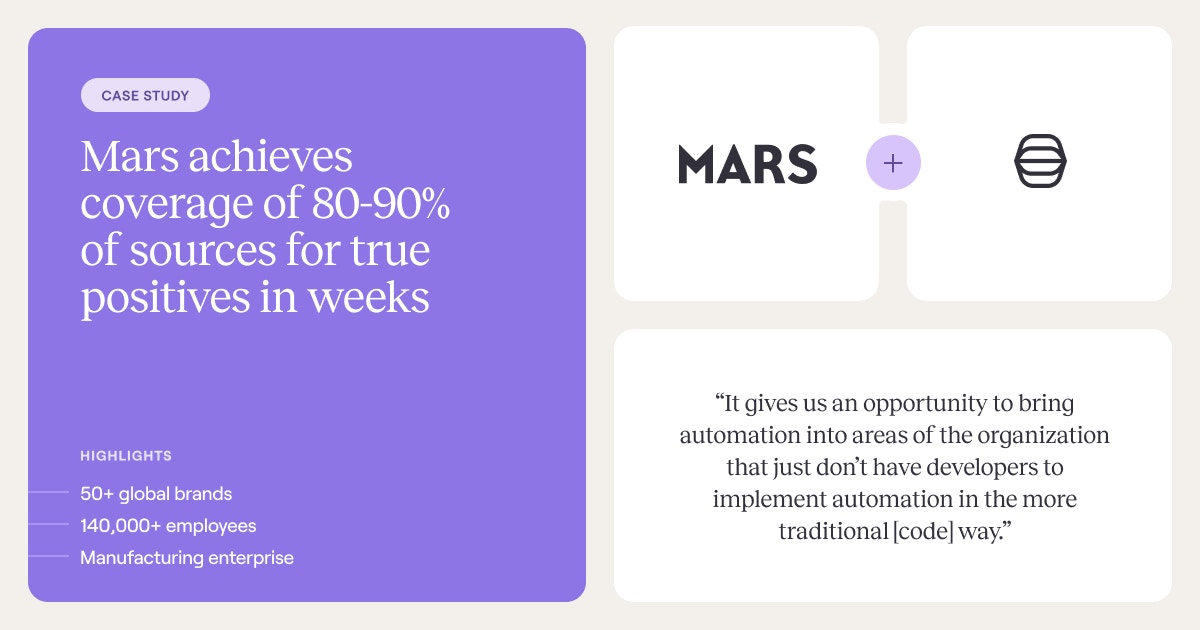
Mars, for example, started with cybersecurity, replaced their legacy security orchestration, automation, and response (SOAR), and consolidated 200 playbooks into 79 stories. Within six months, five teams were building on the same platform, including IT and data analytics. Many active Tines accounts follow a similar trajectory, expanding from one department into multiple.
4. RevOps, finance, and compliance
RevOps teams use intelligent workflows for lead routing and assignment, pulling context from Salesforce, enrichment tools, and scoring models to route leads to the right rep in seconds instead of hours.
Finance teams automate purchase order creation and approval chains that span multiple systems. Compliance teams connect audit workflows across identity providers, ticketing systems, and communication tools. The workflow logic is the same. Only the domain changes.
How to evaluate an intelligent workflow platform
Most intelligent platforms look capable in a demo. The questions that matter are the ones that surface in production, when real data is flowing, real teams are building, and real governance requirements apply.
Six criteria separate platforms that ship from platforms that stall:
Governance: Are audit trails, role-based access, and AI guardrails built into the architecture, or are they a premium add-on? This is where many platforms reveal their limits.
Build speed: How fast can a non-specialist deploy a production workflow? If the answer is months, you've replaced one bottleneck with another.
Integration depth: Can the platform connect to anything with an API, or are you limited to a fixed connector catalog?
AI model flexibility: Can you bring your own LLM, or are you locked into whatever the vendor ships?
Cross-team scalability: Can workflows expand beyond the first team without re-architecting? A platform that works for security but can't extend to IT or operations will hit a ceiling fast.
Total cost of ownership: License price is one line item. Implementation time, connector maintenance, and internal resources required to keep workflows running are the rest. TCO matters more than sticker price.
None of this replaces the organizational work. Clear process ownership, cross-team alignment, and executive sponsorship still determine whether a platform delivers value or becomes shelfware.
The platform handles orchestration, integration, and governance. The organization has to define what good looks like and commit to operating the workflows it builds.
How Tines approaches intelligent workflows
Technology investments keep stalling at the integration layer. AI pilots don't fail because the models are wrong. They fail because nothing underneath connects the systems, teams, and decisions. The organizations getting results solved the plumbing problem first.
Tines was built to be that plumbing. Teams build and run stories (Tines' term for workflows) that combine deterministic automation, agentic AI, and human-led processes on a single governed surface.
The platform connects to anything with an API, with customers averaging 68 integrated tools and no ecosystem lock-in.
In the Tines Voice of Security 2026 report, 92% of security professionals said an intelligent workflow platform would be extremely or very valuable. Tines is where that demand is already showing up: 1.5 billion automated actions per week, 302% year-over-year growth in customer LLM usage, and 94% of pilots advancing to production.
What makes Tines different is where it came from. The platform was born in security, built by former SOC practitioners who understood that governance and auditability can't be afterthoughts.
That foundation now extends to every team that builds on the platform, whether they're running alert triage, IT onboarding, or revenue operations workflows. 75% of Tines’ customers span multiple departments because the workflow patterns are similar.
Ready to see what this looks like in practice? Sign up for our Community Edition for free, or book a demo to talk to a product expert.
Frequently asked questions about intelligent workflow platforms
What's the difference between an intelligent workflow platform and SOAR?
SOAR is security-specific orchestration built around deterministic playbooks. It was designed for a narrower era with fewer tools and simpler alert volumes.
An intelligent workflow platform supports deterministic, agentic AI, and human-led workflows across any team, including security, IT, operations, and finance. SOAR is one use case within the broader platform, not a separate category that meets today's requirements.
Do intelligent workflows replace existing tools?
No. They connect and orchestrate them. An intelligent workflow platform is vendor-agnostic by design. Your existing tools stay.
The platform is the layer that makes them work together, pulling context from your SIEM, taking action in your EDR, updating your ticketing system, and notifying your team in Slack, all within a single governed workflow.
How do intelligent workflow platforms handle AI governance?
Governance is built into the platform architecture: audit trails, AI guardrails, and monitoring. Teams control how much autonomy AI agents get, and every action is logged. Without this layer, AI experiments create shadow workflows that no one can audit, no one can scale, and no one can maintain when the person who built them moves on.
What teams typically use intelligent workflow platforms first?
Security and IT operations teams are common starting points because they face high volumes of structured work across multiple tools. But the same workflow patterns apply to any team managing cross-system processes.
RevOps, finance, HR, and compliance teams adopt the same platform once the initial use case proves value, which is why many customers leverage Tines across multiple teams.